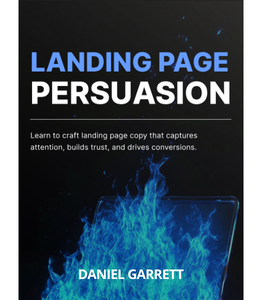
Landing Page Persuasion
Why This Book Is Listed
Selected for combining psychological principles with practical copywriting techniques for landing page optimization, emphasizing ethical persuasion and continuous testing over manipulation tactics.
At a Glance
- Category: Marketing & Sales
- Type: Conversion optimization guide
- Approach: Psychology-driven and practical
- Reading Style: Direct with examples
Short Description
A comprehensive guide to landing page copywriting combining psychological principles with proven techniques for crafting magnetic headlines, irresistible CTAs, and persuasive content that consistently converts visitors into customers.
What You'll Learn
- Crafting attention-grabbing headlines combining clarity, relevance, urgency, uniqueness, and compelling promises
- Creating irresistible CTAs using action-oriented language and personalization (personalized CTAs perform 202% better)
- Applying psychological triggers including curiosity gap, loss aversion, social proof, reciprocity, and authority ethically
- Building trust through narrative consistency, objection handling, testimonial placement, and storytelling techniques
- Leveraging advanced principles like anchoring bias, FOMO, scarcity, and paradox of choice for persuasion
- Implementing continuous improvement through A/B testing, analytics tracking, and user feedback integration
Who This Book Is For
This book is a good fit if you:
- Struggle with low conversion rates despite generating decent traffic to landing pages
- Need to create sales pages, lead generation forms, or promotional content that performs better
- Want to master persuasive copywriting techniques grounded in psychological principles
- Are responsible for conversion optimization and need measurable results to justify budgets
- Create content you want to monetize more effectively through better conversion
- Understand that persuasion requires ethical application of psychology, not manipulation
- Are committed to continuous testing and refinement rather than set-it-and-forget-it approaches
Full Description
Landing pages have seconds to capture attention and compel action, requiring strategic combination of creativity and psychology. Research shows personalized CTAs perform 202% better than generic ones, while first-person phrasing increases click-through rates by up to 90%. The anatomy of attention-grabbing headlines includes clarity (immediately communicating value), relevance (addressing specific audience needs), urgency (creating time-sensitive motivation), uniqueness (differentiating from competitors), and compelling promises (articulating clear benefits). Psychological triggers amplify effectiveness: the curiosity gap creates information void compelling resolution, loss aversion leverages stronger motivation avoiding loss than gaining equivalent value, social proof demonstrates others' positive experiences reducing risk perception, reciprocity triggers obligation when receiving value first, and authority establishes credibility through expertise or credentials. Proven headline formulas provide structure while avoiding clickbait tactics undermining trust or overly clever phrasing obscuring value propositions.
Irresistible calls-to-action combine clear action-oriented language with strong command verbs (Get, Start, Discover, Claim vs. passive Learn More or Click Here), strategic urgency elements creating time pressure without false scarcity, and personalization resonating with specific audience segments. Research demonstrates first-person CTAs ("Start My Free Trial") outperform generic versions ("Start Free Trial") because they increase psychological ownership and commitment. Building trust and emotional connections requires narrative consistency where landing page story aligns with traffic source expectations preventing jarring transitions, proactive objection handling addressing concerns before they derail conversion, strategic testimonial placement at decision points validating claims through peer experiences, and persuasive storytelling techniques transforming abstract benefits into concrete scenarios prospects visualize experiencing. The goal: moving skeptics through awareness to consideration to decision through strategically sequenced information and emotional resonance.
Advanced psychological principles deepen persuasion when applied ethically. Anchoring bias uses initial reference points influencing subsequent judgments—showing premium pricing first makes standard pricing appear more reasonable. Primacy and recency effects mean people remember information presented first and last best, suggesting strategic positioning of strongest benefits. Availability heuristic leverages recent, vivid, or emotionally charged examples feeling more probable than statistics. FOMO (fear of missing out) and scarcity trigger urgency through limited availability or time constraints, while paradox of choice recognizes too many options cause decision paralysis—strategic simplification improves conversion. Social proof manifests through testimonials, user counts, case studies, trust badges, and media mentions building credibility. Reciprocity suggests offering value upfront (free tools, guides, trials) creates obligation reciprocating through conversion or sharing.
Integration ensures cohesion where headlines, body content, and CTAs work together seamlessly guiding readers toward conversion without confusion or friction. Every element should reinforce the central value proposition through consistent messaging, visual hierarchy directing attention to key information, logical flow building case progressively, and multiple conversion opportunities at natural decision points without feeling pushy. Continuous improvement happens through A/B testing headlines, CTAs, layouts, and copy variations measuring actual performance not assumptions, analytics tracking identifying where visitors drop off revealing optimization opportunities, user feedback through surveys or session recordings exposing friction points, and developing unique voice aligning with brand identity while maintaining persuasive effectiveness. The emphasis remains on ethical persuasion building long-term customer relationships through genuine value delivery and trust rather than manipulation tactics generating short-term conversions at expense of reputation and retention. Success comes from understanding audience deeply, simplifying complex value propositions, cultivating empathy, harnessing storytelling power, and staying ahead of emerging trends like voice search optimization and AI-assisted personalization while maintaining human connection and authenticity.