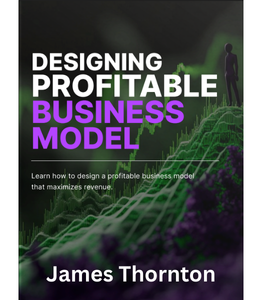
Designing a Profitable Business Model
Why This Book Is Listed
Selected for providing a strategic framework approach to business model design rather than relying on passion or gut instinct, emphasizing data-driven validation and adaptability.
At a Glance
- Category: Business & Entrepreneurship
- Type: Strategic framework guide
- Approach: Data-driven and systematic
- Reading Style: Practical with case studies
Short Description
A strategic framework for designing profitable business models through revenue stream identification, value proposition crafting, resource alignment, and data-driven testing with real-world case studies.
What You'll Learn
- Identifying and diversifying lucrative revenue streams using market research and customer insights
- Crafting compelling value propositions that resonate with target audiences and differentiate from competitors
- Aligning resources, optimizing operations, and building strategic partnerships for sustainable growth
- Implementing data-driven testing strategies and gathering effective customer feedback
- Using the Minimum Viable Product (MVP) approach to validate ideas quickly and efficiently
- Knowing when and how to pivot as market conditions change and new insights emerge
Who This Book Is For
This book is a good fit if you:
- Have innovative business ideas but need structured frameworks to transform concepts into viable ventures
- Struggle to identify sustainable revenue streams or differentiate effectively from competitors
- Want to optimize existing business models and scale profitably with strategic clarity
- Are considering entrepreneurship but unsure where to start beyond passion and gut instinct
- Have launched ventures that failed due to weak business models and want to avoid repeating mistakes
- Need practical frameworks like the Value Proposition Canvas for strategic decision-making
- Understand that successful business models require continuous testing, feedback, and adaptation
Full Description
Turning a great business idea into a profitable venture requires more than passion—it demands a clear strategic framework. Many entrepreneurs fail not from lack of enthusiasm but from building businesses on weak foundational models that can't sustain growth or adapt to market changes. You'll learn to identify and diversify revenue streams using market research and customer insights rather than assumptions. This involves analyzing customer willingness to pay, exploring multiple monetization models (subscriptions, transactions, licensing, advertising), and validating revenue assumptions before significant investment. The approach emphasizes building businesses with clear economic engines rather than hoping profitability emerges eventually.
Creating a compelling value proposition goes beyond listing features—it requires understanding exactly what problems you solve for specific customer segments and why they should choose you over alternatives. You'll use frameworks like the Value Proposition Canvas to map customer jobs, pains, and gains against your products and services, ensuring tight alignment between what you offer and what markets actually need. This clarity in value proposition prevents the common trap of building solutions searching for problems. Resource alignment and operational optimization ensure your business model remains executable and scalable. You'll learn to identify key resources required, build strategic partnerships that extend capabilities without excessive overhead, and optimize operations for efficiency while maintaining quality and customer satisfaction.
Building a business model isn't a one-time task but an iterative process requiring continuous validation and refinement. You'll implement data-driven testing strategies gathering customer feedback effectively through surveys, interviews, and behavioral data rather than relying solely on opinions or assumptions. The Minimum Viable Product (MVP) approach validates core assumptions quickly and efficiently by building the smallest version that delivers value and generates learning. This reduces risk and accelerates feedback cycles compared to building fully-featured products before market validation. You'll learn to design experiments testing critical hypotheses about customer needs, pricing sensitivity, channel effectiveness, and value delivery—making decisions based on evidence rather than intuition.
Markets evolve, customer needs shift, and competitive landscapes change—successful businesses adapt through strategic pivoting when data indicates current approaches aren't working. You'll learn to recognize signals requiring pivots versus temporary setbacks, understanding when to persevere and when to change direction. The book provides real-world case studies demonstrating how successful companies evolved their business models: some adding new revenue streams, others completely reimagining value propositions, and many optimizing resource allocation and partnerships. These examples illustrate practical application of frameworks rather than just theoretical concepts. The emphasis remains on building sustainable, adaptable business models with diversified income sources, clear differentiation, validated value propositions, and systematic approaches to testing and refinement—transforming entrepreneurial vision into thriving profitable reality through strategic clarity rather than hope and hard work alone.