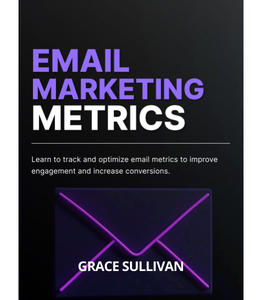
Email Marketing Metrics
Why This Book Is Listed
Selected for focusing on actionable metrics and optimization strategies rather than surface-level email marketing advice, emphasizing data-driven decision-making backed by research and industry benchmarks.
At a Glance
- Category: Marketing & Sales
- Type: Metrics-focused strategy guide
- Approach: Data-driven and analytical
- Reading Style: Technical with case studies
Short Description
A data-driven guide to email marketing metrics covering open rates, click-through rates, conversion optimization, A/B testing, segmentation, automation, and advanced analytics for measurable ROI.
What You'll Learn
- Calculating and optimizing open rates (unique opens/delivered emails × 100) through subject line testing and send time optimization
- Maximizing click-through rates (unique clicks/delivered emails × 100) with clear CTAs and benefit-driven content
- Managing bounce rates and list health through double opt-in, regular cleanup, and email verification
- Understanding conversion rates as the ultimate success metric linking efforts to tangible business results
- Leveraging advanced metrics including email ROI, list growth rate, revenue per email, and customer lifetime value
- Implementing A/B testing, segmentation, personalization, and automation for continuous improvement
Who This Book Is For
This book is a good fit if you:
- Need to prove email marketing ROI and justify budgets with measurable results to stakeholders
- Want clarity on which metrics truly impact bottom line beyond vanity metrics like open rates
- Seek to optimize conversion rates and customer lifetime value through data-driven strategies
- Are ready to go beyond basic metrics into advanced analytics and predictive modeling
- Want to implement systematic A/B testing, segmentation, and personalization programs
- Understand that email marketing excellence requires continuous testing and optimization
- Are committed to staying ahead of emerging trends including AI-powered optimization and interactive emails
Full Description
Successful email marketing requires moving from guesswork to data-driven precision through understanding interconnected metrics. Open rates calculate as unique opens divided by delivered emails multiplied by 100, with optimization strategies including crafting subject lines that avoid clickbait while creating curiosity, testing send times for your specific audience, and personalizing beyond just names through segmentation. A 2024 EmailAnalytics study found including recipient names can increase open rates by up to 26%. Click-through rates (CTR) measure engagement as unique clicks divided by delivered emails multiplied by 100. Improvement tactics include clear action-oriented CTAs with specific value language, visually distinct buttons with contrasting colors, and benefit-driven content building persuasive cases. Research shows emails with images maintain 42% higher CTR when using a 60/40 text-to-image ratio. Managing bounce rates (bounced emails/sent emails × 100) maintains list health by distinguishing hard bounces from soft bounces, implementing double opt-in, regular cleanup, and email verification.
Conversion rates represent the ultimate success metric linking email efforts to tangible business results like sales and retention, calculated as conversions divided by delivered emails multiplied by 100. Boosting conversions requires optimizing landing pages for mobile-responsiveness, ensuring load times under 3 seconds (improving by 1 second increases conversions by 7% according to 2024 Unbounce research), maintaining consistency between email and landing page design, and featuring clear prominent CTAs. Personalization using past purchases, browsing history, and demographics significantly impacts results, as does creating urgency through limited-time offers. A case study demonstrates practical application: an outdoor gear retailer increased open rates from 15% to 28%, CTR from 1.5% to 3.7%, and dropped unsubscribe rates from 0.3% to 0.08% within 3 months through segmentation based on purchase history and browsing behavior, personalized subject lines, redesigned templates with compelling visuals, and preference center implementation.
Advanced metrics provide deeper business intelligence beyond basic engagement. Email ROI calculates as (revenue generated - campaign costs) / costs × 100, directly measuring financial impact. List growth rate tracks subscriber acquisition momentum, forward/share rate indicates content resonance, engagement over time reveals audience lifecycle patterns, revenue per email quantifies monetary value, and customer lifetime value projects long-term subscriber worth. Industry benchmarks for 2024 provide context: average open rate 21.33%, CTR 2.62%, conversion rate 1.22%, unsubscribe rate 0.1%, bounce rate under 2%. However, benchmarks require interpretation by industry, audience demographics, and campaign type—B2B often sees different patterns than B2C, promotional emails differ from transactional. Exceeding benchmarks requires continuous testing, maintaining list hygiene, investing in email design, leveraging automation and AI, and focusing relentlessly on subscriber value.
Future-ready email marketing embraces emerging trends including AI and machine learning for content optimization and send time prediction, interactive emails using AMP for in-email purchases and engagement, privacy compliance with GDPR and CCPA regulations, accessibility optimization for screen readers, dark mode compatibility, and voice assistant readability. Hyper-personalization uses real-time data beyond basic merge tags, while automation sequences nurture leads systematically. The key principle remains consistent: analyze data beyond surface metrics, balance automation with human touch, integrate email with overall marketing strategy, and maintain growth mindset viewing challenges as optimization opportunities. Success comes from systematic testing of subject lines, content formats, send times, segmentation approaches, and personalization tactics—making incremental improvements compound into significant performance gains over time through disciplined measurement and continuous refinement of what resonates with your specific audience.