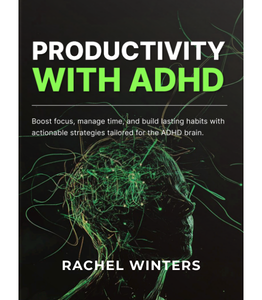
Productivity with ADHD
Why This Book Is Listed
Selected for designing strategies specifically around ADHD brain function rather than adapting neurotypical productivity advice, recognizing that different wiring requires different approaches.
At a Glance
- Category: Self-Help & Personal Development
- Type: Practical guide for neurodivergent productivity
- Approach: ADHD-specific and brain-based
- Reading Style: Direct and implementation-focused
Short Description
A comprehensive approach to productivity designed specifically for ADHD brains, covering executive function strategies, workspace organization, time management, and habit engineering that work with your natural wiring.
What You'll Learn
- Understanding how executive function works differently with ADHD and why traditional methods often fail
- Creating strategic workspace zones that reduce cognitive burden and support focus
- Implementing time management tactics designed for time blindness and attention variability
- Engineering habits that stick using ADHD-friendly techniques like implementation intentions and habit stacking
- Managing energy levels around natural rhythms rather than fighting against them
- Leveraging ADHD strengths like creativity, hyperfocus, and dynamic thinking as competitive advantages
Who This Book Is For
This book is a good fit if you:
- Have ADHD and find traditional productivity advice ineffective or frustrating
- Experience executive function challenges with planning, organization, time management, or impulse control
- Struggle with time blindness, working memory issues, or getting lost in hyperfocus
- Feel tired of being told to "just focus" without understanding neurological differences
- Want to leverage ADHD strengths like creativity and dynamic thinking rather than only managing deficits
- Need practical implementation strategies beyond clinical diagnosis information
- Understand that success with ADHD means working with your brain's natural tendencies, not against them
Full Description
Many adults with ADHD find that traditional productivity systems never seem to work, leading to frustration despite genuine effort and intelligence. The issue isn't lack of capability—your brain is wired differently, and that difference can be advantageous when you use strategies designed for how ADHD brains naturally operate. Research by Dr. Russell Barkley shows people with ADHD often experience 30-40% delay in executive function development, meaning organizational abilities work differently than chronological age would suggest. This explains why neurotypical planning methods prove ineffective. You'll learn to understand executive function as your brain's control center managing planning, organization, impulse control, and working memory—each presenting distinct challenges that require unique approaches rather than generic solutions.
Your physical and digital environment significantly impacts cognitive function and productivity. Princeton University Neuroscience Institute research demonstrates that working in cluttered spaces restricts your brain's ability to focus and process information efficiently. You'll implement strategic zone management: dividing your space into purpose-built areas like a Focus Zone for deep work with minimal decoration, a Quick-Task Zone for brief activities with essential supplies, a Reference Zone for information storage with labeled containers, and a Storage Zone for long-term items. Each zone gets equipped with necessary tools while maintaining minimal visual clutter, creating natural flow that supports productive behavior and reduces the cognitive burden of transitioning between task types. Digital organization receives equal attention—file management with hierarchical structures, communication protocols preventing email overload, and task tracking systems ensuring nothing falls through cracks.
ADHD brains experience time differently than neurotypical brains, making traditional time management advice often counterproductive. Rather than forcing rigid schedules, you'll develop personalized systems matching your attention patterns and energy fluctuations. Techniques include body doubling (working alongside others to reduce task initiation resistance), modified Pomodoro with flexible intervals matching your natural focus cycles rather than strict 25-minute periods, task batching to minimize context-switching overhead, and priority matrices distinguishing urgent from important. Habit formation requires different approaches for ADHD brains—you'll engineer environments making desired behaviors easier through strategic friction removal. Implementation strategies include "If-Then" planning, habit stacking that anchors new behaviors to existing routines, accountability partnerships leveraging social motivation, reward systems providing immediate gratification, and flexible frameworks allowing adaptation rather than all-or-nothing abandonment after single slips.
Physical health directly impacts ADHD symptom management and executive function performance. You'll learn energy management around natural rhythms—identifying peak performance periods for demanding tasks while scheduling low-energy activities during predictable dips. The wellness foundation covers sleep optimization (sleep deficits dramatically exacerbate ADHD symptoms), nutrition strategies providing steady energy and supporting neurotransmitter production, regular exercise improving focus and mood regulation through neurochemical changes, and stress management preventing overwhelm that shuts down already-challenged executive functions. The book emphasizes leveraging ADHD strengths: creativity and innovation enabling unexpected connections, hyperfocus allowing deep immersion in engaging tasks, adaptability and high energy when properly channeled. Famous entrepreneurs like Richard Branson attribute success to ADHD thinking style, demonstrating how different cognitive processing becomes competitive advantage when you develop strategies working with your brain rather than against it.