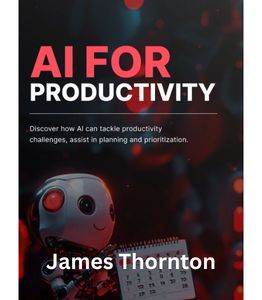
AI for Productivity
Why This Book Is Listed
Selected for providing practical implementation guidance on AI productivity tools as of 2023, covering specific platforms and use cases rather than theoretical discussions about artificial intelligence.
At a Glance
- Category: Business & Entrepreneurship
- Type: Practical tool guide
- Approach: Implementation-focused with case studies
- Reading Style: Direct and technical
Short Description
A comprehensive guide to AI-powered productivity tools covering intelligent time management, communication automation, workflow optimization, content creation, and personal development through practical applications.
What You'll Learn
- Implementing intelligent calendar apps like Motion and Reclaim.ai for dynamic scheduling and task optimization
- Using AI-enhanced task management with Todoist, Any.do, and Asana for prioritization and workflow efficiency
- Streamlining email and communication through AI sorting, response suggestions, and meeting transcription
- Automating workflows with Zapier, Make, and IFTTT connecting apps and eliminating repetitive tasks
- Accelerating content creation using ChatGPT, Jasper AI, Canva, and DALL-E for writing and design
- Leveraging personalized AI learning platforms and health apps for skill development and wellness tracking
Who This Book Is For
This book is a good fit if you:
- Struggle with time management, prioritization, or meeting deadlines consistently
- Feel overwhelmed by emails and meetings that consume productive time
- Need better project coordination and workflow optimization for your team
- Want to accelerate content creation through AI writing and design assistance
- Seek work-life balance through intelligent scheduling and automated task management
- Are ready to implement AI tools without requiring advanced technical skills
- Understand that AI productivity enhancement requires learning new platforms and adapting workflows
Full Description
While artificial intelligence may seem like science fiction, AI tools have become practical reality in everyday productivity applications as of 2023. You already interact with AI through virtual assistants like Siri, Alexa, and Google Assistant responding to voice commands, smart recommender systems on Netflix and Spotify suggesting content based on your preferences, and language processing tools like Grammarly improving your writing. This guide shows how to embrace AI strategically across common productivity challenges: struggling to prioritize tasks and manage schedules, drowning in emails and correspondence, coordinating teams and tracking project progress, time-consuming content creation for writing and design, and maintaining fitness routines or learning new skills. The focus remains on practical implementation of user-friendly tools rather than theoretical AI concepts.
Intelligent calendar apps create dynamic schedules adapting to priorities automatically. Motion builds AI-powered calendars that rearrange events based on urgency and deadlines without manual intervention. Reclaim.ai optimizes your calendar by automatically scheduling tasks, habits, and breaks ensuring balanced productive days. Clockwise protects focus time blocks from interruptions while working with platforms like Asana and Slack, providing time management statistics showing where boundaries succeed or fail. Task management software with AI integration includes Todoist prioritizing tasks and setting intelligent reminders based on your habits while offering personalized productivity insights, Any.do sorting tasks and suggesting completion times based on behavior and calendar events, and Asana identifying potential project roadblocks through forecasting while suggesting workflow optimizations for efficient on-time completion.
Communication and collaboration tools leverage AI for efficiency gains. Email management apps sort important messages intelligently, suggest responses, schedule optimal send times, and filter spam more effectively than traditional rules-based systems. Collaborative platforms include Slack with AI-powered search and channel organization, Microsoft Teams utilizing AI for meeting transcription and action item extraction, Monday.com with AI automations, and ClickUp offering AI writing assistance plus task prioritization. Automated transcription tools like Otter.ai transcribe meetings in real-time providing searchable notes, while Fireflies.ai records calls, generates summaries, and extracts action items. Workflow automation through Zapier connects apps automating repetitive tasks, Make (formerly Integromat) creates complex automation with visual builders, and IFTTT sets up simple conditional automations linking services without coding.
Content creation acceleration uses AI writing assistants and design tools. ChatGPT generates text for purposes ranging from emails to articles, Jasper AI creates marketing copy and blog posts, Copy.ai produces creative copy for advertisements and landing pages. Graphic design tools include Canva's Magic Write and background remover features, DALL-E generating images from text descriptions, and Midjourney creating artistic visuals from prompts. Personal productivity enhancement covers AI learning platforms like Coursera and Khan Academy offering AI-recommended courses, Duolingo using AI for personalized language learning paths, plus health and wellness apps: MyFitnessPal tracking nutrition with AI-powered insights, Headspace providing personalized meditation recommendations, and Fitbit utilizing AI for activity tracking and health insights. The guide emphasizes selecting tools based on specific challenges, evaluating integration capabilities and user-friendliness, and implementing gradually rather than attempting wholesale workflow transformation simultaneously.